Saturday, May 23, 2015

Ca. 1820s Coat and Trousers, National Museum of Denmark

I've had this suit in my head all week but just finally found the source. It is from the National Museum of Denmark and is a perfect example of the deepening lapels that took hold in the early 1820s.


Link to the museum page: http://natmus.dk/historisk-viden/temaer/modens-historie/1790-1840/bukser-og-jaket/

The museum's website describes it as: "Long pants and morning dress from the 1820s....informal summer clothing....[Coat] is of white and blue narrow striped cotton . The pants are light yellow Nankin (sic) . In front flap with 3 buttonholes. Linning (sic) and crew (sic) are torn at the top."

Evolution of the collar and lapels is especially apparent wen compared to the common style of 5-10 years prior, as seen on this American linen coat from the MET, accession # 1997.508 and a coat of similar cut worn by Granville-Leveson, 1st Earl Granville in England, both ca. 1815.


Collars and lapels sat very noticeably higher at that point. Look closely here and you can see that William Croghan, Sr. of Locust Grove near Louisville, KY was keeping up with evolving fashions when his portrait was painted in 1820 at the age of 68 by John Wesley Jarvis (Collection of Historic Locust Grove, Louisville, KY):


Tuesday, March 24, 2015

1912 Rolls

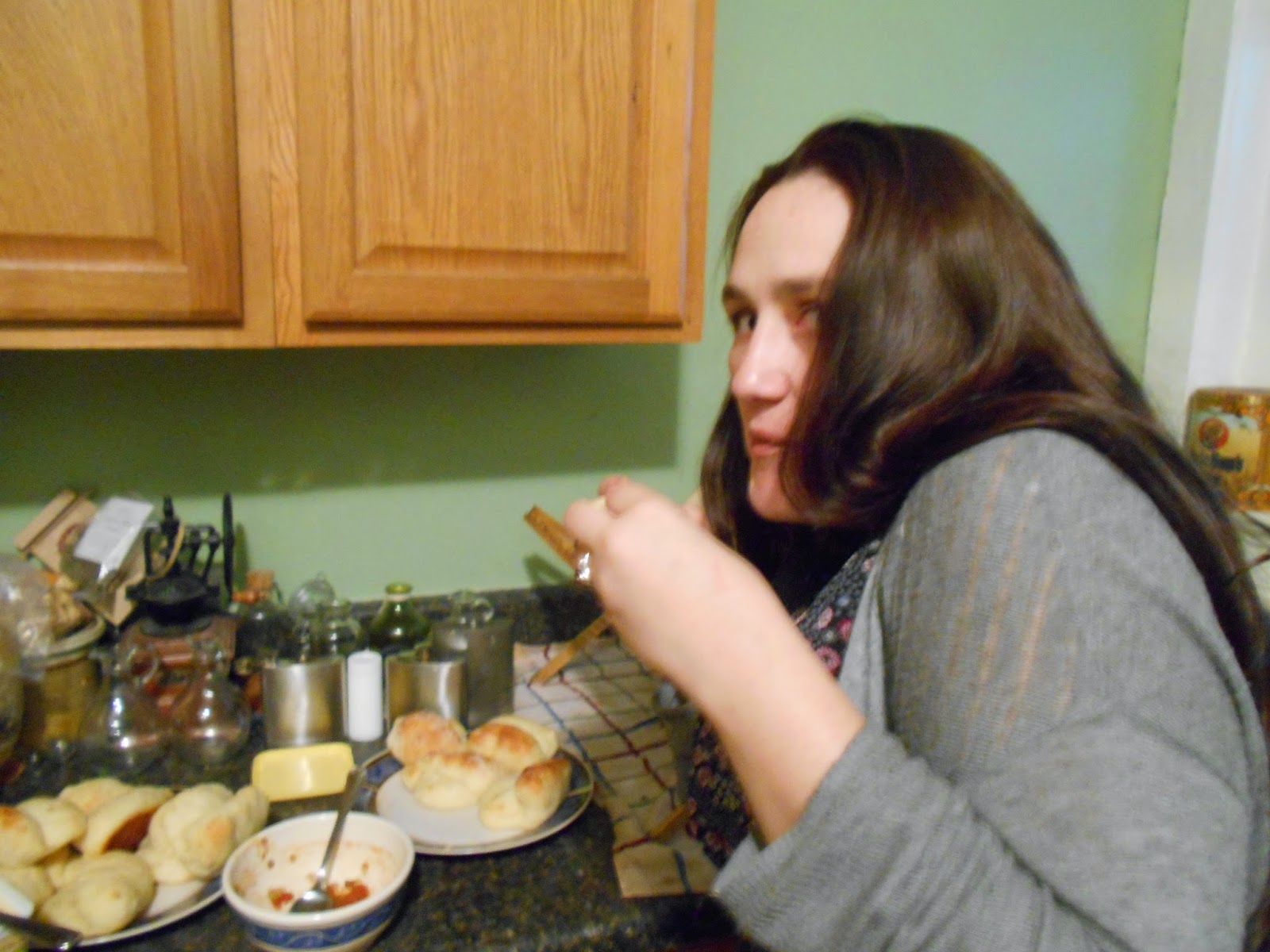
Have been loving experimenting with recipes in the 1912 Lowney's Cookbook I found at Locust Grove's book sale recently. Tonight, I had great success with their recipe for "Parker House Rolls."


They took all afternoon with the various rises and all but the result was an amazing, big, fluffy, buttery roll. If you would like to give it a try:


(Part 1)


(Part 2)

Since the oven temp was vague, I cross reference with another recipe for Parker House Rolls from my 1924 cookbook, which recommended a 400 deg. oven. Amy found the experiment successful:


Enjoy!

Yours, & c.

The Victorian Man


Sunday, March 8, 2015

Where Have I Been?

Can't believe it's been almost a year since I last wrote- it's been a busy one! Returned to the staff at Historic Locust Grove here in Louisville, this time as Program Coordinator. Never thought my actual job would be planning and executing programs at a 200+ year old historic site. Just to make things better, my office is in a loft perched on top of ca. 1810 log house.


Got to return to the museum where history first came to life for me in the first place (launching all you see here!), Heritage Village at Sharonville (Ohio), to do a special first person presentation as John Tipton. NOT a feel good story! The audience looked shocked. I will be returning to do a new presentation in March of 2016.


And, of course, tons of research an development on Victorian clothing and material culture, mostly my favorite book ends- the 1840s and the 1880s-90s. Made an 1840s frock coat and trousers for my friend Keith who does and 1842 interpretation at Locust Grove. You can't see it in the photo but the trousers are a nice, subtle blue plaid.


Wasn't happy with the way the last 1840s frock coat I made for myself was fitting in the arms but, luckily, my friend Michael Ramsey and I spent a weekend geeking out on Victorian clothing construction and he helped me diagnose the issue. Made a new one, happy with the result. Here with my 1790s friend Bob at my friends' Lance and Regan's Christmas party. Photo by buddy Asha.


Mostly everything else was just trying to get everything in shape to shoot it to the next level. One ongoing project- I had such good experience with Past Patterns' 014 Mid 19th Century Summer Trousers pattern that I have been using them as the basis for trousers of the 1880s-1890s by tweaking the back a little based on some details from the day and using Jason MacLochlainn's chart on page 86 of The Victorian Tailor to modify the knee and cuff widths. Results have been promising!


So- hopefully back on track and can share more actual information on the world of real Victorian men soon!


Yours &c,

The Victorian Man

Thursday, March 6, 2014

Making the Butterick 1890 Men's Shirt Pattern

Around age 10 or so when history became a tangible concept to me that I wanted to recreate, the first period that I automatically keyed in on was the 1880s. Not sure why, it just happened. And although most of the periods I have worked to recreate have been earlier, the drive to experience the material culture of the very late 19th century is still very much alive in me. So, a year or so ago, I ordered Past Patterns' reprint of Butterick's men's shirt pattern from 1890:


This is a straight reprint of the original with only the original instructions- not a modern pattern intended for modern sewers. The first time I opened it up and spread it out, I was overwhelmed and put it back away for months. But not too long ago, I got it back out with a more patient and determined attitude and could not be happier with the result:


So happy that if I don't make a couple more soon, this one is going to wear out- it gets incorporated into my day to day wardrobe as often as possible.

Two major things you need to know before getting started- the pieces are not labeled and the instructions are not legible enough and are too squished together to expect to be able to follow them effectively while making it up. They are also not as complete as a modern sewer may prefer so it helps if you have made a yoke back shirt before (in my case it was the 1920s repro pattern from EvaDress, which is also outstanding, but its instructions are actually much less complete).

My solution was to, first, transcribe the instructions with logical breaks to make following them more manageable (I will be happy to forward my transcription to you if you are undertaking this project). Luckily, there is a list of pattern pieces at the beginning, so it was just a matter of matching from there. The most major unexpected part of this for me was that, instead of grading one pattern piece for the different neck sizes (15, 15 1/2, 16), there are separate pieces for the top portion of the shirt front. You match the appropriate top with the one front for your size:


(Notice- they also lay opposite ways.) There is also a separate yoke piece for each size. For the collar band and the top portion of the collar, there are notches to indicate where to fold them over to achieve your size. I only applied the collar band as I wanted to be able to attach separate collars, but I found that the piece needed to be folded in another 7/8 of an inch in order to fit in the space provided (and my neck). 

Making tacks at what were perforation points on the original pattern is essential but do not cut the notches at the edges of the top piece or yoke piece- with the seam allowance being only 1/4", the cut out portion will not be enclosed in the seam. These notches are also not at all necessary for matching the pieces effectively.

The instructions for the front placket piece are impeccable and should be followed exactly. Also repeated for the similarly shaped piece on the sleeve.

For the cuff piece, I used a 1/2 inch seam allowance at the top instead of the specified 1/4 inch because it made it more closely correspond to the the dimensions of the cuff on the extant piece featured in William Brown III's Thoughts on Men's Shirts 1750-1900 and another extant piece on loan to me from a friend. Each extant garment also guided me on button placement for the cuff, which is set slightly back from center (for more observations on that, see this post on my other blog):


I also used these two extant shirts to determine how I fit the cuff to the sleeve piece- both had a small gathered portion in the center and pleats on either side. Fitting the yoke is better explained, which only involves a gathered portion on each side:


You see here, too, that I also added a button hole in the center back for passing a stud through to attach separate collars. There should also be a buttonhole on each side of the front of the collar band.

Here are some of my collar studs- on the left are a pair that were a Christmas gift from Amy from Mr. Alan Jeffries Fine Gentlemen's Apparel  and on the right are some of my antique china pieces.


I used advertisements from the 1890s to determine a common quantity of buttons on the front (3 seemed reasonably standard) and placed them accordingly. They are all antique china buttons:


If you are intending to use separate collars for this shirt, I recommend using either Timeless Stitches TSM-716 Collars and Cuffs for Men:


Or one of the excellent collars offered ready made from Amazon Dry Goods (which I am wearing here, accompanied by Fred the cat):


If you have a few shirts under your belt, I highly recommend this pattern. Beyond the great result, it is a wonderful experience knowing that you are working with the same resource that stitchers in the 1890s were. If you have any problems, please drop me a line!

Yours &c.

The Victorian Man

Thursday, February 6, 2014

My First Special Exhibit- George Croghan: Fallen Hero

Thanks to Historic Locust Grove, the Arts and Culture Partnership at the University of Louisville, and Dr. John Hale, Director of Liberal Studies at the University of Louisville, I had the opportunity last year to design, build, and curate my first special museum exhibit. To commemorate the bicentennial of Major George Croghan's successful defense of Ft. Stephenson, Locust Grove decided to launch the first of what will hopefully be a continuing series of special temporary exhibits; this one to showcase the life story of the tragic second son of the original owners of the historic home.


Exhibit Banner

Other museums, private collectors, and researchers provided a great deal of support in addition to the resources we had available at Locust Grove. In particular, the curatorial staff at the Frazier History Museum were tirelessly helpful and generous.


Here is a walk through some of what was on display. The exhibit was located in a room of a ca. 1810 log house that has been incorporated into Locust Grove's modern museum gallery.


Representation of Croghan's early life. In the foreground are images of the miniatures of his parents, William and Lucy Croghan, the original owners of Locust Grove. The actual miniatures are in Locust Grove's collection but were too fragile to be displayed. The ca. late 18th Century hunting sword (collection of the Frazier History Museum), ca. early 19th Century hunting bag and bullet mold (my collection), and ca. early 19th Century powder horn (collection of Nathanael Logsdon/Historic Tunnel Mill) represent Croghan's enthusiasm for hunting in his early life. The books belonged to George Croghan and his brothers, John Croghan and William Croghan, Jr; they were all successful students.


George Croghan was the only one of his brothers to follow in the footsteps of his father and uncles by joining the military. He was first with Kentucky Volunteer Dragoons during William Henry Harrison's campaign in the Indiana Territory in 1811. The campaign culminated in the Battle of Tippecanoe where Croghan served as aid to Colonel Boyd. When the War of 1812 came the following year, he was made a captain in the regular United States Army (17th Infantry Regiment) and promoted to the rank of major following his contribution to the defense of Fort Meigs and urging of his superiors by his father. The uniform in this exhibit (collection of Historic Locust Grove) belonged to George Rogers Clark Floyd who was also at Tippecanoe (it does not reflect the style worn by Croghan- the dragoons had been directed to wear plain blue single breasted coats by Major Daviess). The sword was likely carried by a militia officer or NCO around the time of or during the War of 1812 (collection of Nathanael Logsdon/Historic Tunnel Mill; consultation on origin by Ric Cusick). The pipe tomahawk head (collection of Frazier History Museum) is also from about the same time as the war and represents the Native American forces that engaged Harrison's army at Tippecanoe under Tecumseh's brother, "the Prophet."


The high point of Croghan's life was his defense of Fort Stephenson in August, 1813. When the intent of attack upon the fort by British General Proctor's combined force of British regulars and Native allies became known to William Henry Harrison (still Croghan's superior), he sent orders from his his base at Seneca Town (10 miles from Ft. Stephenson) to Croghan that he was to abandon the fort, burn it down, and join him at Seneca Town. The courier carrying the orders got lost in the woods and, by the time he arrived, the presence of Proctor's Native allies near by was already apparent. Croghan responded to Harrison's orders stating that a safe retreat had become impossible and that he intended to remain at Ft. Stephenson and attempt a defense. This insubordination caused Harrison to have Croghan arrested and brought to him at Seneca Town. Croghan successfully argued that a defense was the only option and was returned to his command. With 150 men and a single 6-pound cannon known as "Old Betsy," Croghan forced Proctor's force to retreat. They had 500 British regulars, 700-800 Natives, howitzers on the river and multiple 6-pounders on land.  The details of the battle are fascinating but perhaps too long of a story to go into here. Afterwards, Croghan was promoted to Lieutenant Colonel and moved to the 2nd Regiment of Rifles.

The book in this display is an 1815 copy of The Portfolio (collection of Lou Scholtz) detailing Croghan's defense of Fort Stephenson, a basic account of his life, and an engraved image of him. The sword with the hilt in the fore ground (collection of the Frazier History Museum) is an American officer's sword from the War of 1812 period. The sword laying across it is a 1795 pattern British officer's sword (collection of the Frazier History Museum). The rifle and shako (hat) (collection of Michael Cooper) are reproductions reflecting equipment used by the U.S. rifle regiments late in the war, during the time Croghan was serving with them. The reproduction pattern 1808 cartridge box (collection of Nathanael Logsdon/Historic Tunnel Mill) is the same type likely carried by troops of the 17th US Infantry during the Battle of Fort Stephenson.


Closer View


The Portfolio, 1815, collection of Lou Scholtz


Croghan's life following the war was a catastrophe. He married Serena Livingston of New York, the Livingstons being one of the richest most powerful families in the country. George and Serena had several children over the course of their marriage; three survived to adulthood. He bought a plantation near New Orleans and moved his family there. Serena did not favor the location or the climate and George eventually sold it to a Mr. Bell of New York. Mr. Bell found, though, that the horses on the plantation were emaciated and the sugar works had never been completed because Croghan had never paid the workers building it. By Louisiana state law at the time, this created a lien on the property; it really was not Croghan's to sell. He and Serena escaped New Orleans by cover of night back to Kentucky. George would spend most of the rest of his life trying to pay off the consequences. Partially due to the influence of his friend, Andrew Jackson, Croghan returned to New Orleans in 1825 as Post Master. Not long after he received the rank of full Colonel and Inspector General with the U.S. Army and resigned from the post office. An audit revealed that he had been embezzling funds, partially to pay off debt from the plantation and partially to fuel a toxic drinking and gambling habit that was just now becoming apparent. Indications are that he attempted suicide by cutting his wrists. Serena was able to get him to Pennsylvania where she did her best to keep the situation quiet. He was able to keep his new position with the army but, from 1826-1841, his behavior grew steadily worse. Family and army correspondence reflect continuous drunken spectacles and extreme irresponsibility with money followed by pledges to improve and periods of behaving well around family, only to return to the same patterns when back on the road.


Bottle, decanter and glasses collection of Historic Locust Grove. Early 19th Century bank notes recreated by Albert Roberts. The sword (collection of Historic Locust Grove) is the only one known to still exist that belonged to George Croghan. It dates to 1821 or later so was with him either during his Inspector General or Mexican War service. Donated by his descendants. The medal in the back (collection of Historic Locust Grove) was awarded to Croghan by Congress in 1835 for his 1813 defense of Fort Stephenson. It was the result of his long standing struggle with William Henry Harrison over what Croghan considered slanderous remarks and insufficient recognition for the defense. It was the only time Congress awarded such and honor so long after the fact. The two miniatures in the front are John Croghan and George Croghan (both collection of Historic Locust Grove). No matter how bad things got, John never failed to do whatever he could to support George. The Bible in the rear was a gift to Serena from George on New Years Day, 1838. Possibly one of many attempts to prove that he was going to clean himself up.


In 1841, Croghan moved back to Locust Grove, now owned and occupied by his brother Dr.John Croghan, the perpetual bachelor. He cleaned up his act, assisted John with his other property, Mammoth Cave, and joined the local temperance society. The Bible in the foreground (collection of Historic Locust Grove) belonged to him. Still plagued by debt, Serena legally separated himself from him, in part to protect the property and inheritance of her and her children. She was aided in this by their only surviving son, St. George Croghan. Ultimately, he served in the Mexican War as a Colonel with his friend and long time Locust Grove neighbor, Zachary Taylor. The Colt Dragoon revolver (1980s reproduction by the Colt company, collection of the Frazier History Museum) represents how far technology had come since his last battle. In war, he seemed to find himself again, but contracted cholera and died in New Orleans in 1849, three days before John died at Locust Grove. The ribbon and ceramic pitcher both bear his image and are commemorative pieces from Fremont Ohio, the site of Fort Stephenson, where he has always been honored as a hero.

Oldest daughter Mary Angelica (painting at left, collection of Historic Locust Grove) and youngest daughter Serena "Tiny" (photograph at right, collection of Historic Locust Grove) both married and moved to San Francisco, California along with their mother (George's widow) Serena. Many of their descendants are still there and have been a tremendous help to Locust Grove since it has been transformed from a farm into a museum. St. George inherited Locust Grove following his uncle's and father's deaths. He served in the Confederate Army as a Colonel and was shot and killed in West Virginia in 1861.


Mary Angelica Croghan Wyatt, Collection of Historic Locust Grove


Lt. Col. George Croghan, ca. 1816, by John Wesley Jarvis. Collection of Historic Locust Grove


Serena Livingston Croghan, ca. 1816, Collection of Historic Locust Grove

Saturday, November 2, 2013

Update: Bias Cut Striped Waistcoat

Though I was continuously beset with circumstances that prevented stitching progress since my first post on the subject, I finally finished my 1840s-50s bias cut striped waistcoat based on Past Patterns #018.


As I have found to be usual from this company, the pattern worked perfectly and created an ideal period silhouette. The only modification I made was to attach the chest padding (which I made from wool from a heavy military blanket) rather than making it detachable- but this was just a matter of personal preference. My interfacing was cotton twill which did the job nicely and created clean, crisp lines. I wound up using polished cotton for the back, common in the period- Regency Revisited happened to have the perfect thing on hand:


The buckle is from Kanniks Korner. Ted Cash Manufacturing Co. had the perfect buttons:


And I used a reproduction ca. 1850 print cotton from Windham Fabrics for the lining:


The more thoroughly I delve into the 1840s, the more at home in it I feel. I highly recommend this pattern!

Your, &c.,

The Victorian Man

Monday, October 7, 2013

Early Tail Coats: How They Were Different

The period from ca. 1790-1820 is a unique and frequently misunderstood period in the evolution of men's fashion.  There were dramatic departures from general formulas that had been in place since the ca. 1680s but the innovations that ultimately lead to the fashions that would create the vastly different male image of the 1820s forward had not yet been conceived.  The 1790s saw the birth of the tailcoat but the form in which they existed until the 1820s had much more to with the coats of the 18th Century than anything post 1820.

When laid flat, the pieces of the typical pre-1820 tail coat are shaped basically the same as a coat of the late 18th Century but with growth across the front and cutaways in the lower front bodies to form tails (plus various other evolutions). The diagram of this coat on the attached link shows the beginnings of the evolution- the front body has barely been formed into tails in this 1790-95 example:


Click for flat diagram: http://www.lacma.org/sites/default/files/FF_Patterns_Manscoat.pdf

The diagram of this coat from ca. 1812-14 shows how the coat body typically evolved from there; the basic form lasted through the first two decades (and sometimes beyond) of the 19th Century:


Diagram by Betsy Bashore:


The body was still cut in one piece as it had been since it took hold as the typical male top layer in the 1680s (elaborated on nicely in Part 2 of Noah Waugh's The Cut of Men's Clothes 1600-1900).


1817

This remained the case until about 1818 when modifications began to be made to tighten the fit of the body, which would ultimately lead to the pinched waist, flared bottom look that would take hold in the 1820s and last (in changing forms over time) through the 1840s, into the 1850s. 


1827


1839-40


ca. 1840s- MET Museum

The first step toward this was the introduction of a "fish" at the waist, which began the "tightening trend" (first appearing in 1818 according to Waugh, 113; indeed, a thorough survey of reliably dated period images corroborate that there is no evidence of change before then). 

In the 1820s, waist seams and body darts began the process of being introduced (although not universally) to aid in the image created by coats such as those in the images above. The Tailor's Friendly Instructor by J. Wyatt from 1822 is an interesting look at this evolution in progress: the structure of the front body of his tail coat diagram is still cut in one piece with only the frock coat possessing a seam at the waist and dart in the body.

Tail coats seem to be misunderstood by those attempting to recreate the Regency/Federal period today most commonly because of a "projecting backward" of what has been understood to "be" a tailcoat since just prior to the Victorian era: waist seams and body darts will creep in on garments intended to represent an era when they did not exist, creating a fit and silhouette that also did not exist (an error which I made, myself, for years).  The tailors of the Regency/Federal period only had knowledge of the developments that had been made to that therefore only had that to work with. It is also important to keep in mind that over the 30 or so years that are often lumped into the label "Regency," many trends came and went within the time frame, so limiting research for a coat to no more than a five year span is important.

I am often asked what pattern on the market is best for making a "Regency" coat. The best solution I have found is to take this pattern and "boil it down" to its basic shape (eliminate all of the military details).  You will then have a basic template to work from; the front edges as is will meet along your center front (overlap for buttons/holes must be added).  You can then build the civilian details onto the basic shape too create the specific civilian look you desire (the sleeves ARE supposed to reach the knuckles; fiddling with where the body cuts across to form the tails will likely be necessary):


I know more than one person (myself included) that had to take an inch or more out of the side seems to achieve a good snug fit for their size but, other than that, it works out beautifully. It is important to keep in mind that items representing later periods are often mislabeled "Regency" and even assigned a date range that literally would include the Regency era. This is an example that applies the term "Regency" and recommends it for recreating the years 1810-30 but, when the fit, details, and diagram are checked against primary sources and the evolution outlined here, it is actually not correct until the 1820s are well under way and would actually be a very useful resource for recreating fashions into the 1830s (rather than cutting it off at 1830).


Recreating early tailcoats can be a tricky question but understanding how they evolved and doing your own research based in primary sources limited to a five year span or so before making any purchases, it can be done. My most recent attempt, ca. 1805-10, based on the process I recommended above:


Yours, &c.

The Victorian Man (Looking Backwards)