Saturday, November 2, 2013

Update: Bias Cut Striped Waistcoat

Though I was continuously beset with circumstances that prevented stitching progress since my first post on the subject, I finally finished my 1840s-50s bias cut striped waistcoat based on Past Patterns #018.


As I have found to be usual from this company, the pattern worked perfectly and created an ideal period silhouette. The only modification I made was to attach the chest padding (which I made from wool from a heavy military blanket) rather than making it detachable- but this was just a matter of personal preference. My interfacing was cotton twill which did the job nicely and created clean, crisp lines. I wound up using polished cotton for the back, common in the period- Regency Revisited happened to have the perfect thing on hand:


The buckle is from Kanniks Korner. Ted Cash Manufacturing Co. had the perfect buttons:


And I used a reproduction ca. 1850 print cotton from Windham Fabrics for the lining:


The more thoroughly I delve into the 1840s, the more at home in it I feel. I highly recommend this pattern!

Your, &c.,

The Victorian Man

Monday, October 7, 2013

Early Tail Coats: How They Were Different

The period from ca. 1790-1820 is a unique and frequently misunderstood period in the evolution of men's fashion.  There were dramatic departures from general formulas that had been in place since the ca. 1680s but the innovations that ultimately lead to the fashions that would create the vastly different male image of the 1820s forward had not yet been conceived.  The 1790s saw the birth of the tailcoat but the form in which they existed until the 1820s had much more to with the coats of the 18th Century than anything post 1820.

When laid flat, the pieces of the typical pre-1820 tail coat are shaped basically the same as a coat of the late 18th Century but with growth across the front and cutaways in the lower front bodies to form tails (plus various other evolutions). The diagram of this coat on the attached link shows the beginnings of the evolution- the front body has barely been formed into tails in this 1790-95 example:


Click for flat diagram: http://www.lacma.org/sites/default/files/FF_Patterns_Manscoat.pdf

The diagram of this coat from ca. 1812-14 shows how the coat body typically evolved from there; the basic form lasted through the first two decades (and sometimes beyond) of the 19th Century:


Diagram by Betsy Bashore:


The body was still cut in one piece as it had been since it took hold as the typical male top layer in the 1680s (elaborated on nicely in Part 2 of Noah Waugh's The Cut of Men's Clothes 1600-1900).


1817

This remained the case until about 1818 when modifications began to be made to tighten the fit of the body, which would ultimately lead to the pinched waist, flared bottom look that would take hold in the 1820s and last (in changing forms over time) through the 1840s, into the 1850s. 


1827


1839-40


ca. 1840s- MET Museum

The first step toward this was the introduction of a "fish" at the waist, which began the "tightening trend" (first appearing in 1818 according to Waugh, 113; indeed, a thorough survey of reliably dated period images corroborate that there is no evidence of change before then). 

In the 1820s, waist seams and body darts began the process of being introduced (although not universally) to aid in the image created by coats such as those in the images above. The Tailor's Friendly Instructor by J. Wyatt from 1822 is an interesting look at this evolution in progress: the structure of the front body of his tail coat diagram is still cut in one piece with only the frock coat possessing a seam at the waist and dart in the body.

Tail coats seem to be misunderstood by those attempting to recreate the Regency/Federal period today most commonly because of a "projecting backward" of what has been understood to "be" a tailcoat since just prior to the Victorian era: waist seams and body darts will creep in on garments intended to represent an era when they did not exist, creating a fit and silhouette that also did not exist (an error which I made, myself, for years).  The tailors of the Regency/Federal period only had knowledge of the developments that had been made to that therefore only had that to work with. It is also important to keep in mind that over the 30 or so years that are often lumped into the label "Regency," many trends came and went within the time frame, so limiting research for a coat to no more than a five year span is important.

I am often asked what pattern on the market is best for making a "Regency" coat. The best solution I have found is to take this pattern and "boil it down" to its basic shape (eliminate all of the military details).  You will then have a basic template to work from; the front edges as is will meet along your center front (overlap for buttons/holes must be added).  You can then build the civilian details onto the basic shape too create the specific civilian look you desire (the sleeves ARE supposed to reach the knuckles; fiddling with where the body cuts across to form the tails will likely be necessary):


I know more than one person (myself included) that had to take an inch or more out of the side seems to achieve a good snug fit for their size but, other than that, it works out beautifully. It is important to keep in mind that items representing later periods are often mislabeled "Regency" and even assigned a date range that literally would include the Regency era. This is an example that applies the term "Regency" and recommends it for recreating the years 1810-30 but, when the fit, details, and diagram are checked against primary sources and the evolution outlined here, it is actually not correct until the 1820s are well under way and would actually be a very useful resource for recreating fashions into the 1830s (rather than cutting it off at 1830).


Recreating early tailcoats can be a tricky question but understanding how they evolved and doing your own research based in primary sources limited to a five year span or so before making any purchases, it can be done. My most recent attempt, ca. 1805-10, based on the process I recommended above:


Yours, &c.

The Victorian Man (Looking Backwards)

Saturday, July 6, 2013

The Photo That Started it All!

From about the age of 10 or so I was preoccupied with the common things that people touched and used during the Victorian Era.  It was quite a while before I learned to differentiate among the decades that comprised this long period.  I was very excited to find, though, that I could own some of it. One of the first sorts of items I discovered that I could possess easily were photographs.  This was my first, found in a pawn shop not far from where it was taken in the late 1990s or 2000:

When I found it, I was pretty sure it fell within the Victorian Period, or at least the "Long 19th Century," and that was enough- it was a moment frozen in time that I possessed.  In the mean time, I have pretty finitely broken down the fashion trends during the entire 19th Century and beyond and found it obvious that it is characteristically 1890s.  The specifics make it even more valuable to me- not as a collector of antiques based on monetary value- but just as one preoccupied with common material culture.  A friend of mine (and fellow recreator of historic clothing), Michael Ramsey, and I have even been planning to modify a pattern for a very similar suit (available through http://agelesspatterns.com/) to "wearable" sizes:


This one dates to 1894 but is only available in the original size- 32- small even for the period.

Yours & c.

The Victorian Man

Photo From My Collection- From a Pornographer's Studio???

A few nights ago, I needed to unwind with something entertaining but informative yet not overly technical.  So, I reached for this book:


Louisville: Murder and Mayhem: Historic Crimes of Derby City.  It is based on actual events; well written yet not the most scholarly work around. Being fascinated with my home town's Victorian history, this was just the diversion I needed.  The title of the selection "Your Friendly Neighborhood Pornographer" caught my interest.  It was about a Louisville man, Henry Zinc, who the US Post Office caught peddling nude images of women through the mail in 1893.  His partner was allegedly "well known" local photographer Walter Elrod.  Elrod denied the charge but said that nearly every other photographer in town was involved in the trade and that the only images he ever gave Zinc were "works of art" having been given to him by a friend.  I immediately recognized the name "Elrod," though, as being present in my stash of antique photographs.  Suddenly, what had seemed to be a rather plain image of a late 19th Century Louisville woman had more of a story attached:


For years, I have had an image from the alleged pornographer's studio- only a a quick bicycle ride from where I currently live.  Her dress indicates the photo was taken in the 1880s or early 1890s- right at the time he was accused of having operated in "the business."

Yours & c.

The Victorian Man

Tuesday, June 4, 2013

A Day at Tunnel Mill

Amy and I had never attended a Civil War event but Historic Tunnel Mill, run by our friend Nathan Logsdon, was hosting one this past weekend. Our clothes are a bit early for that but he said that would not be a problem so we dressed out and stopped by for a few hours.


We had been to the site before and knew it was beautiful but it was even better buzzing with people.  There were demonstrations, we caught up with old friends, met some new ones, explored Tunnel Mill's various historic attractions, and strolled along the beautiful creek bank.

Historic Tunnel Mill is located on property owned by Boy Scouts of America.  It features the John Work House, a ca. 1811 historic home:


The house had fallen into extreme disrepair and been heavily vandalized when Logsdon struck a deal with them to be able to head up a non-profit effort to restore it and operate it as an interactive, hands on historic site.

Nathan Logsdon portraying the owner of Tunnel Mill during the Civil War. The event was based on a Confederate plot to compromise the mill, which was supplying the Union Army.

Vandals of various sorts continued to be a problem after the restoration began.  A rotating team of volunteers have ensured the the site is constantly manned and cooperation with Clark County Police finally seem to have curbed much of the problem.  Stephen Priddy has logged many hours in this effort, usually in a more modern security uniform:


What has resulted is a testament to what a coming together of people who care about seeing a project happen for the good of the broader community can accomplish.  Volunteer workers and craftsman have brought the house a long way toward reliving its 1811 glory. Shots of the best parts are being kept under wraps at the moment but here is one of my favorite photos I took at the 2011 Candlelight Tours of the staircase, festooned in garland and crowned with a wreath, lit only by a candle chandelier:


The feeling of standing there could have been lifted from a page of Dickens.  Later that evening, we got to (briefly and extremely carefully) experience a Christmas tree lit with small candles; a Victorian indulgence best left to the professionals!  In addition to restoring the structures already on the site, several 19th-early 20th Century log structures have been disassembled, transported to the property, and are in the process of being reassembled:


Nathan and his team of volunteers have also been working on replicating other sorts of period structures on the property.  Mine and Amy's personal favorite was the mid-19th Century soldiers hut. Outside:


And in:


Tested and 100% functional.

The ghost stories of local lore had taken over the identity of Tunnel Mill for years, but through the restoration efforts, the actual history is being rediscovered and made available to all who venture by.  Nathan had Amy and I pose this photo to recreate one such ghost story in an effort to let people know that there isn't anything to be afraid of


Only the world of the 19th Century to rediscover


Stop by and visit Historic Tunnel Mill- only 30 minutes from Louisville!


Monday, May 20, 2013

Shirts Are To Be Covered

One of the best college courses I ever had was on the Gilded Age taught by Dr. Daniel Vivian.  The guidelines for the final term paper were rather broad so I chose to do mine on men's clothing trends 1880-1915. It seemed straight forward at first since I have spent a great deal of time working to understand this but it was unexpectedly challenging to prove basic aspects of men's dress during the period (the basics of which had endured for many years prior), which had become ingrained in me, to someone who was not familiar with the subject. I used this 1912 barroom scene to illustrate to the reader how commonly accepted it was during the Gilded Age that a man's shirt should be at least somewhat covered by another garment when going out of doors or in mixed company.  All of the customers, while seemingly working class and not at all well to do, are observing this custom.  Three out of the four are wearing jackets.  They have come in from the outside and will be leaving again before the bar is closed.  The only subjects not covering their shirts are the bartenders- settled in, the first ones in and last ones out, and isolated from company that could be offended.  The practice of men wearing a shirt as an outer layer is a very modern practice- it did not occur to men in 1912 who were even just going out for a beer with the guys after a hard day's work


The practical application of this is that a garment layer of a washable material and that was easier to obtain was necessary between the body and more expensive and specialized garments such as the waistcoat and coat.  Body soils disintegrate textiles and the outer layers (often made of wool) were seldom washed.

Yours &c.,
The Victorian Man


Monday, May 13, 2013

Making Mrs. Beeton's Tea Cakes

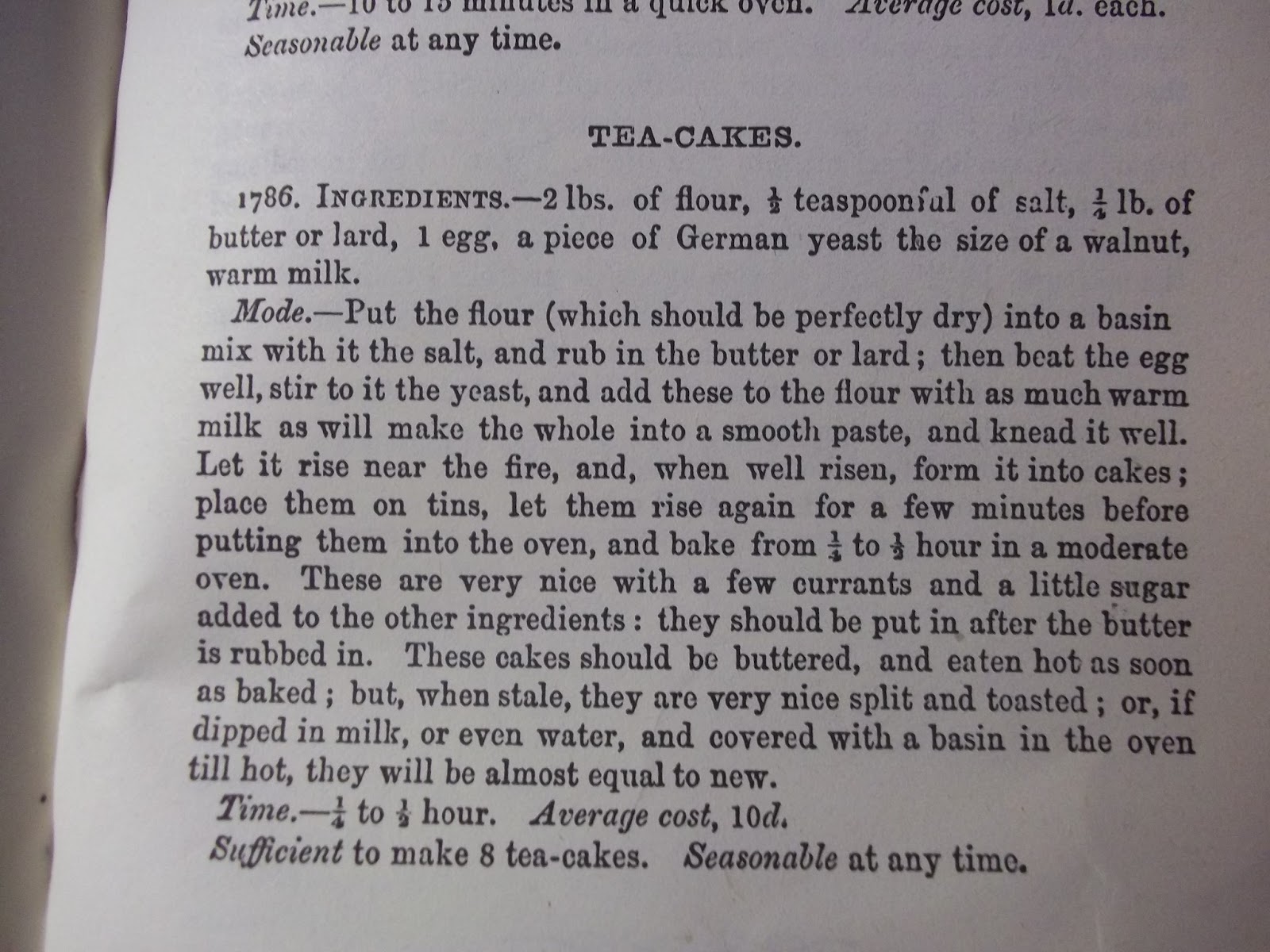
While perusing this reprint of the 1861 edition of Mrs. Beeton's Book of Household Management


I found this recipe for tea cakes that looked easy enough to recreate and thought would be nice for a picnic that Amy and I were planning to take.


Unfortunately, I wound up sick when we had the picnic planned and noticed (late) that they were best served fresh out of the oven, so they became breakfast on Sunday instead.  (One disclaimer- I had it in my head that tea cakes should be of a reasonable personal size and made them about the size of a biscuit but in hind sight, I realized that Mrs. Beeton was getting only eight cakes from this large recipe.  I only made a quarter of this recipe and wound up with six, so she was apparently intending for them to be much larger.)

The main aspect I had to be careful about adapting correctly to my modern oven was the baking temperature being referred to only as "moderate." I thought I remembered that being more or less 350 deg. but to be sure, I jumped ahead in time briefly to reference this (original) book I have from 1924:


While recipes arranged in the way we are used to now (with an ingredient list, baking temp., etc.) were not very new by this point, this was still a transitional period for cookbooks. I also have one from 1920 where the recipes are written basically the same way as Mrs. Beeton's. The valuable thing about this book for projects like I was working on is that it combines the old descriptions for oven temperature (e.g. "moderate") with a specific temperature below the recipe. For example:

This makes cross referencing between the descriptions and specifics of oven temperature possible. "Moderate," however, ranges from 300 deg. to 375 deg. in this book, though, so some guess work is still required. In the end, I settled on 350. Converting pounds to cups, the "German yeast" to something more readily available, and doing only one quarter of the recipe to make it a more manageable experiment, the ingredient list became:

1 2/3 Cup Flour
1/8 tsp. Salt
2 Tbsp. Butter (softened)
1 egg (beaten)
1/2 Tbsp. Active Dry Yeast
1/2 Cup (give or take) warm milk

The best results will come from leaving the butter out for 1 1/2-2 hrs before mixing to come to room temperature, then beating it with a fork rather than microwaving or otherwise melting.

Combine the flour and salt, then work in the butter with a fork. Dissolve the yeast in the warm milk (may take more or less- use enough to make a soft, smooth, but not too sticky dough) and add the milk, yeast, and egg to the rest of the ingredients. Knead and cover. Leave to rise until doubled. An easy way to make this part of your breakfast is to mix it just before bed and leave it to rise overnight.

Once risen (or in the morning) preheat your oven to 350, make the dough into biscuit-sized cakes, place on a cookie sheet lined with parchment paper, and leave for 15 minutes or so to rise a bit more.


Bake for 15-20 minutes. Serve soon after coming out of the oven with butter and/or preserves.  We found them to be VERY good!


Our simple bread with coffee and tea breakfast would not at all have been considered a full breakfast in Victorian England. More on that later!

Yours &c.,

The Victorian Man